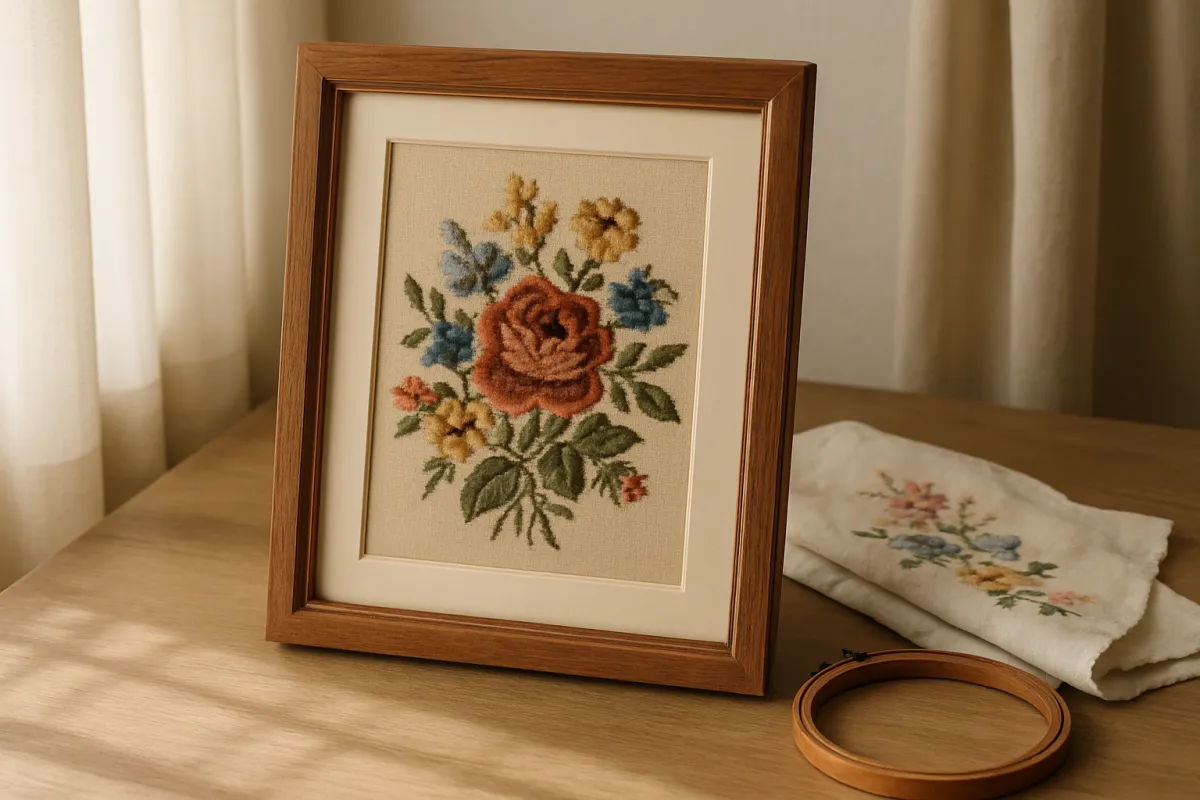
What to Do With Vintage Embroidery: Framing & Preservation Tips
That box of vintage embroidery in your closet deserves better than a closet. Whether it's your grandmother's cross stitch, a hand-embroidered pillowcase, or a piece of needle art someone poured a hundred hours into, textiles are meant to be seen — and preserved properly so the next generation gets to enjoy them too. Here at Tricia's Rose City Framing in Tyler, Texas, I've framed everything from great-grandmother's embroidered jeans to century-old textiles, and I promise you: there's a right way and a whole lot of wrong ways to handle these treasures. Let me walk you through it.
1. Understand Why Vintage Embroidery Needs Special Care
Vintage embroidery isn't just fabric — it's thread, dye, fiber, and time, all working against you if you don't treat it right. Old textiles are fragile. The threads can be brittle, the fabric can be acidic, and sunlight is a silent assassin that fades colors before you even notice it's happening. That's why you can't just slap it in a dime-store frame and call it done.
The biggest enemies of vintage needle art are light, acid, moisture, and physical stress. When someone brings me a piece here in Tyler, the first thing I do is hear the story — because every treasure has a story — and the second thing I do is assess its condition. According to the Smithsonian's textile conservation guidelines, improper storage and display cause the majority of avoidable textile damage.
Never display textiles in direct sunlight or under harsh artificial light.
Avoid adhesives, tape, or glue directly on the fabric — ever.
Keep humidity stable; extreme swings cause fibers to expand and contract.
Pro Tip: If your embroidery is stored folded, don't leave it that way for years. Fold lines become permanent creases and eventually weak spots where the fabric splits.
2. Clean Vintage Embroidery Gently — or Don't Clean It at All
Oh my — this is where I see people get into trouble. Folks want their heirloom to look fresh, so they toss it in the wash or scrub at a stain, and next thing you know, the colors bleed and the piece is ruined. When it comes to vintage embroidery, less is almost always more.
If your piece is delicate, antique, or irreplaceable, the safest answer is often to leave the cleaning to a textile conservator. Some pieces can handle a very gentle hand-wash, but many can't — the dyes weren't colorfast, and old fabric doesn't behave like new fabric. What we don't know, we'll research, and when a piece needs professional cleaning beyond framing, I'll tell you honestly and point you in the right direction.
Test any cleaning method on the least visible corner first.
Never wring, twist, or scrub embroidered fabric.
Skip the ironing — heat can scorch fibers and flatten the dimensional stitchwork you love.
Pro Tip: If you spot moths or evidence of pests, freeze the piece in a sealed bag for 72 hours before doing anything else. It stops an infestation from spreading to the rest of your linens.
3. Choose Conservation Framing to Preserve Vintage Embroidery
Here's the thing I won't apologize for: conservation framing costs more than the frame from the big box store, and it's worth every penny. Real preservation framing uses acid-free, archival materials and — this is critical — UV-protective glass or acrylic that shields your embroidery from the light damage I mentioned earlier. That protection is the difference between an heirloom that lasts fifty more years and one that fades to nothing in five.
When I frame vintage embroidery at my shop in Tyler, Texas, I use acid-free mounting boards, museum-quality mats, and glazing that filters ultraviolet light. I also leave a small gap so the fabric never touches the glass — trapped moisture against glazing is a recipe for mold. The Library of Congress preservation resources back up every one of these standards, and I've framed pieces for clients who work with the Library of Congress themselves, so I take this seriously.
Ask specifically for acid-free, archival, conservation-grade materials.
Insist on UV-protective glass or acrylic — not standard glass.
Make sure the fabric is spaced away from the glazing surface.
Pro Tip: If a framer can't explain how they'll mount your textile without adhesive, walk away. Real conservation framing never glues fabric down.
4. Mount Embroidery the Right Way Without Damaging It
Mounting is where the craft really shows. The wrong mounting method — pins pushed through the fabric, glue, or heat-activated backing — will damage vintage embroidery permanently. The right method holds the piece secure while letting it breathe and, most importantly, remaining fully reversible so the fabric can be removed unharmed someday.
For most heirloom embroidery, I hand-stitch the textile to an acid-free backing using conservation techniques — no adhesive touches the piece itself. For dimensional or delicate work, we might use a shadow box so the stitchwork stands proud instead of being crushed flat under glass. This is often a case of framing by committee: I've got three framer mentors — two Master Picture Framers and one CPF — I'll call on for the trickiest textiles, because there's no ego in getting it right.
Reversible, non-adhesive mounting protects the piece's future.
Dimensional embroidery often needs a shadow box for proper display.
Hand-stitched mounting is gentler than pins or tension pressure.
Pro Tip: Double-sided embroidery — like a piece with beautiful work on both faces — can be framed in a floating double-sided frame so you can flip it and see both sides. I did exactly that with a client's great-grandmother's embroidered jeans.
5. Display Vintage Embroidery Where It Belongs
Once your embroidery is framed properly, where you hang it matters just as much. All that conservation work goes out the window if you hang the piece on a wall that gets blasted by afternoon sun or above a fireplace where heat and soot rise. Think about the light, the temperature, and the humidity of the spot before you drive in that nail.
I love when clients bring photos of their walls, or tell me about their home and their travels and their family. Clients are collaborators here — we pick mat colors and frame styles together so the finished piece reflects your personality and your decor, not some assembly-line default. That's the joy of shopping local over big box: you actually have a say.
Hang embroidery on interior walls away from direct sunlight.
Keep pieces away from kitchens, bathrooms, and fireplaces.
Rotate displayed textiles occasionally to even out light exposure.
Pro Tip: If a piece is exceptionally valuable or sentimental, consider displaying a high-quality photograph of it and storing the original in an acid-free box. You get to enjoy the image while the treasure stays protected.
What I've learned about vintage embroidery after years in the field
I never set out to be a picture framer — I was studying communication in college, half-expecting to become the next Barbara Walters. But somewhere along the way I fell in love with framing, and textiles became one of my favorite things to work on. I'm not an artist, but I am creative, and framing needle art takes both an analytical mind and a creative one. You've got to solve the engineering problem of holding fragile fabric safely, and then make it beautiful. Job well done means both.
The biggest thing I've learned is that every treasure has a story, and with vintage embroidery, those stories run deep. Somebody's grandmother sat by a window for hundreds of hours making that piece. When a client hands me something like that, sometimes there are tears, sometimes there are huge smiles — and I want to hear all of it. That story shapes how I frame it. The embroidered jeans I mentioned? That client cried when she saw them finished, and so did I a little, if I'm honest. You can read more about how we work at Tricia's Rose City Framing.
What makes my approach different is that I treat every single item that comes through my door as if it were my own — because to somebody, it's irreplaceable. I won't take shortcuts, and I won't apologize for the cost of doing it right. What we don't know, we'll research. And when a piece is beyond me alone, I lean on framing by committee. That's not a weakness — that's how you protect a 100-year-old heirloom the right way.
How Tricia's Rose City Framing helps you preserve your vintage embroidery
At Tricia's Rose City Framing here in Tyler, Texas, I offer full-service conservation framing built specifically for vintage and heirloom textiles. I'm a Certified Picture Framer, and I've framed needle art, quilts up to 79"x76", century-old documents, animal skin, and three-dimensional treasures — so your grandmother's embroidery is in experienced hands. Every piece gets acid-free archival materials, UV-protective glazing, and reversible, non-adhesive mounting done with real care.
We handle everything from simple embroidered samplers to complex double-sided pieces and dimensional shadow boxes. You'll be part of the process — we'll choose mats and frames together so the finished result fits your home and honors the piece. Quality over quantity, integrity above all, done on time as promised.
Come see us at 214 Shelley Dr, Tyler, Texas, 75701, call (903) 360-7004, or visit www.rosecityframing.com to get started. Bring the story — I can't wait to hear it. Love you, and have a great day. Indeed.
FAQ
How do I frame vintage embroidery without ruining it?
Use conservation framing with acid-free materials, UV-protective glazing, and reversible, non-adhesive mounting so the fabric never gets glued or pinned through. The embroidery should also be spaced away from the glass to prevent moisture damage. At my Tyler, Texas shop, that's the standard for every textile that comes in.
Should I wash old embroidery before framing it?
Usually not without professional guidance — vintage dyes often aren't colorfast and old fabric can tear or bleed when washed. If cleaning is truly needed, a textile conservator is your safest bet. When in doubt, bring it to me and we'll figure out the right path together.
How much does it cost to frame vintage embroidery?
Conservation framing for textiles costs more than a standard frame because it uses archival materials, UV-protective glass, and specialized hand-mounting techniques. I won't apologize for the cost — it's what keeps your heirloom safe for another fifty years. I'll always give you a fair, honest quote up front.
Can double-sided embroidery be framed so I can see both sides?
Yes — a floating double-sided frame lets you flip the piece and enjoy the stitchwork on both faces. I've done exactly this with heirloom pieces, including a client's great-grandmother's embroidered jeans. It's one of my favorite techniques.
Where can I get vintage embroidery framed near Tyler, Texas?
Rose City Framing right here in Tyler is exactly the place — as a Certified Picture Framer, Tricia works with vintage embroidery and heirloom needle art regularly, using acid-free mats and UV-protective glass to keep decades-old stitching from fading or deteriorating further. Bring your piece in for a free consultation, and she'll walk you through the best preservation approach for that specific fabric and thread.