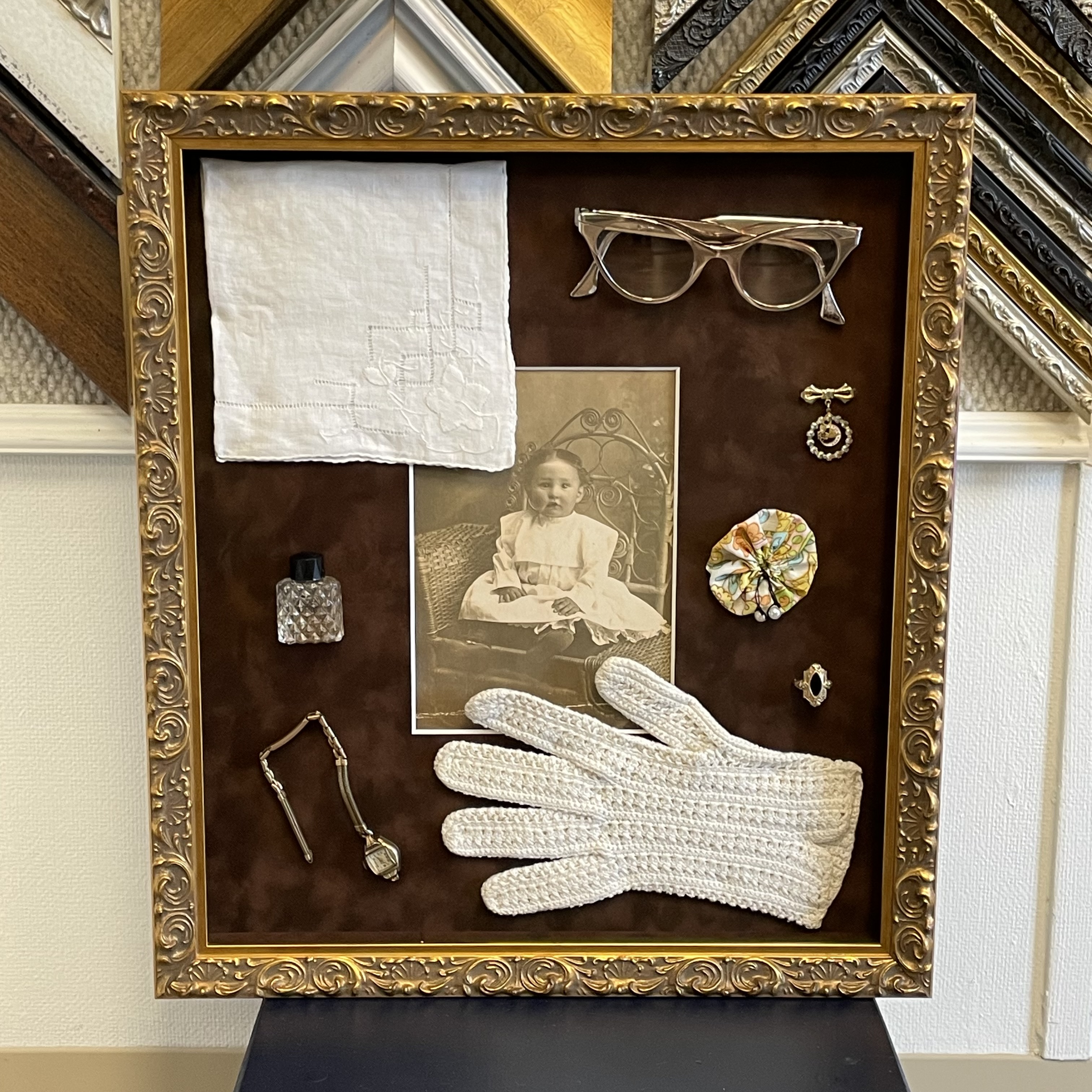
How to Preserve and Frame a Family Heirloom
To preserve and frame a family heirloom so it lasts for years, use acid-free, archival materials next to the piece, UV-filtering glazing to protect it from light, and reversible mounting that holds it in place without glue, tape, or anything permanent. At Tricia's Rose City Framing in Tyler, Texas, we build the whole design around the object itself, so the frame protects your treasure while it displays it beautifully. The goal is simple: keep it safe, keep it stable, and keep it looking the way it does the day you hand it to us. Below, we'll walk you through exactly what that looks like.
1. Why Acid-Free, Archival Materials Matter for Preservation Framing
The single most important thing touching your heirloom should be acid-free. Paper, mats, backing boards, and mounting corners all come into contact with your item, and ordinary materials can carry acids that slowly discolor and weaken what they touch over time. Archival materials are designed to stay chemically stable, so the mat beside your grandmother's letter or the board behind a child's first drawing supports it instead of working against it.
When we design a preservation frame, we think about every layer that sits near the object. The mat, the backing, the hinges or corners holding the piece, even the tape — all of it should be rated safe for long-term contact. You can read more about why these standards exist from the Library of Congress preservation resources at loc.gov.
- Acid-free mats keep the border from yellowing and transferring onto your item
- Archival backing boards give flat, stable support behind the piece
- Mounting corners and hinges hold things gently, without adhesive on the item itself
Pro Tip: If a mat has ever been pressed right up against your photo or document, that's exactly the spot to watch — bring it in and we'll take a look at how it's holding up.
2. How UV-Filtering Glazing Protects Your Heirloom From Light
Light is one of the quietest things working on a framed piece, and UV-filtering glazing is how you slow it down. Ultraviolet light fades inks, dyes, and photographs, and once color shifts, it doesn't come back. Conservation-grade glass and acrylic filter out a large share of UV rays, which helps the colors in your heirloom stay truer for far longer.
Glazing isn't one-size-fits-all, and that's a good thing. For a piece you'll hang where the afternoon sun comes through, more protection is worth it. For a three-dimensional object or a textile, a lighter acrylic may be the smarter, safer choice. We walk you through the options so the glass fits both the item and the wall it's going on.
- UV-filtering glass and acrylic reduce fading from sunlight and bright indoor light
- Acrylic is lighter and shatter-resistant — often the better pick for large or heavy items
- The right glazing depends on where the piece will live in your home
Pro Tip: Even with great glazing, a wall that gets steady direct sun is a hard place for any heirloom — a slightly shadier spot gives it an extra margin.
3. What Reversible Mounting Means — and Why It Keeps Your Treasure Safe
Reversible mounting means your heirloom is held in place without any permanent glue, tape, or trimming — so it can always be removed exactly as it came in. This is the heart of preservation framing. Nothing we do should change the object or make it impossible to undo later. Whether it's a letter, a certificate, a quilt, or a photograph, the piece should be able to come out of the frame as whole as the day it went in.
Different items call for different reversible methods. Paper and documents are often held with archival hinges or corners. Textiles are a different craft entirely — we hand-stitch fabric onto a padded, acid-free support so the weight is carried gently across the piece instead of pulling at one point. The method changes, but the principle never does: hold it securely, and leave it changeable.
- Paper and documents: archival hinges or mounting corners, never tape on the item
- Textiles and needle art: hand-stitching onto a padded, acid-free backing
- Dimensional objects: custom supports that cradle the piece without glue
Pro Tip: If someone ever tells you a frame has to be "sealed" or glued to stay put, pause — with the right approach, secure and reversible go together.
4. Preserving Different Kinds of Family Heirlooms
Different heirlooms need different care, so the first step is always understanding what the object actually is. A century-old document, a wedding quilt, a vellum drawing, and a photograph all behave differently, and a frame that's perfect for one can be wrong for another. That's why we don't start with the frame — we start with the story and the material in front of us.
Over the years our team has framed a wide range of treasures: century-old documents, vellum, animal skin, textiles and needle art, shadow boxes, and three-dimensional objects. We've even framed a cherished family quilt. Each one needed its own plan, because a flat paper document and a heavy, soft quilt ask completely different things of a frame.
- Documents and letters: acid-free housing, UV glazing, hinged or cornered mounting
- Quilts and textiles: padded support and hand-stitching to carry the weight evenly
- Dimensional keepsakes: shadow boxes with custom supports and room to breathe
Pro Tip: Bring the whole thing, not a cropped photo of it — the edges, the back, and the condition all help us design the right preservation plan.
5. How to Care for a Framed Heirloom So It Lasts for Years
Once your heirloom is framed with preservation materials, keeping it well is simple: hang it out of direct sunlight, away from heat and damp, and leave the archival layers alone. The framing does the hard protective work. Your part is choosing a good spot and resisting the urge to "improve" the mounting at home later.
Avoid hanging treasured pieces directly over a fireplace, in a steamy bathroom, or on a wall that bakes in sun all afternoon. Stable, moderate conditions are what help colors and materials hold. And if you ever want to update the look down the road, that's exactly what reversible mounting is for — the piece can be re-matted or reframed without harm.
- Keep it out of direct, all-day sunlight and away from heat sources
- Avoid high-humidity rooms like bathrooms and uninsulated spaces
- Dust the glass gently; never spray cleaner directly onto the frame
Pro Tip: If you move or redecorate, take a second to check the new wall — a cooler, shadier spot is always a gift to a framed heirloom.
What I've learned about preserving family heirlooms after years in the field
Every treasure has a story, and after years at the work table, I can tell you the story is where the right frame begins. When you hand us a letter, a quilt, or a child's first painting, we want to hear what it is and why it matters — because that tells us how it needs to be protected and how you want to live with it. We treat every single item that comes through our door as if it were our own.
What makes our approach different is that we don't force your heirloom into a one-size-fits-all package. We solve the hard ones as a team — what we call framing by committee — and what we don't know, we research. When a project calls for more experience, we're never too proud to consult our framer mentors. That's how a treasured letter and a child's first artwork both end up safe, stable, and beautiful on a wall.
We also believe you should have a say in everything — mat colors, frame style, how it's displayed — so the finished result reflects your home and your personality, not a template. Preservation and beauty are not a trade-off. You can see more of how we think about it at Rose City Framing.
And honestly? This has been a joy since day one. There's nothing quite like handing a family their heirloom back, framed the right way, and watching them realize it's going to be here for the next generation too. Job well done.
How Tricia's Rose City Framing helps you preserve and frame your family heirloom
At Tricia's Rose City Framing in Tyler, Texas, we're a full-service custom frame shop, and preservation framing is right at the center of what we do. We work with acid-free and archival materials, UV-filtering glazing, and reversible mounting, and we've handled everything from 1-by-1-inch items up to 11-by-11-foot pieces — documents, textiles, needle art, shadow boxes, and dimensional keepsakes included. Our team includes two Certified Picture Framers, and we bring that training to every heirloom that comes across the table.
When you come in, we start with your story. We'll talk through the material, where you want to hang it, and how you want it to look, then build a plan that protects the item while it shows beautifully in your home. You collaborate with us the whole way, so the finished frame feels like yours.
If you're holding onto something you treasure and you want it framed with care, we'd love to see it. Bring it by, or reach out through Tricia's Rose City Framing and tell us the story behind it — we serve Tyler and the surrounding Northeast Texas communities, and we'd be glad to take good care of it with you.
FAQ
How do you preserve and frame a family heirloom?
To preserve and frame a family heirloom, use acid-free archival materials next to the item, UV-filtering glazing to guard against fading, and reversible mounting that holds it without glue or tape. At Tricia's Rose City Framing in Tyler, Texas, we design the whole frame around the object so it stays safe and stable while it's displayed. The exact method depends on whether the piece is paper, textile, or a three-dimensional keepsake.
What materials should touch an heirloom inside a frame?
Only acid-free, archival materials should touch an heirloom inside a frame — the mat, backing board, hinges, and mounting corners should all be rated safe for long-term contact. Ordinary materials can carry acids that discolor and weaken what they touch over the years. Keeping the layers nearest the item archival is one of the most important steps in preservation framing.
Does UV glass really protect framed photos and documents?
Yes — UV-filtering glass and acrylic protect framed photos and documents by filtering out a large share of ultraviolet light, which is a leading cause of fading. Colors, inks, and dyes shift when they're exposed to light over time, and that change can't be reversed. Pairing good glazing with a spot out of direct sun gives an heirloom the best chance to stay true.
Can an heirloom be framed without damaging or altering it?
Yes — with reversible mounting, an heirloom can be framed without any glue, tape, or trimming, so it can always be removed exactly as it came in. At Tricia's Rose City Framing in Tyler, Texas, we use archival hinges and corners for paper and hand-stitching for textiles, which hold the item securely while keeping everything changeable. Nothing we do should permanently alter your treasure.
Where should I hang a framed family heirloom in my home?
Hang a framed family heirloom out of direct, all-day sunlight and away from heat and humidity, such as over a fireplace or in a bathroom. Stable, moderate conditions help colors and materials last, and preservation framing does the rest. A cooler, shadier wall is always a gift to a treasured piece.