How Are Custom Frames Actually Made?
Custom frames are made by hand, step by step: our team measures your artwork precisely, helps you choose the mat and moulding, cuts the mat and glass to exact size, cuts and joins the moulding into a frame, and then fits everything together with proper backing and hardware so it hangs securely and stays protected. At Tricia's Rose City Framing in Tyler, Texas, every one of those steps is done by trained, certified hands, not by a machine running on autopilot. It's a craft that blends an analytical mind with a creative one. And once you've seen what really goes into it, you'll never look at a frame on a wall the same way again.
1. It All Starts With Measuring (And It Has to Be Exact)
Before anyone picks up a single tool, the first job is measuring your artwork — and we mean down to the sixteenth of an inch. A frame that's even a hair off won't sit right, and the piece inside can shift over time. Everything that comes after depends on getting this number right the first time.
When you bring something to our table in Tyler, we measure the actual art, not a guess. We note whether the piece needs room to "breathe," whether it'll float on the mat or tuck under it, and how much mat border will flatter it. Those early measurements become the blueprint for the mat, the glass, and the moulding all at once.
- We measure the artwork itself, not the old frame it came in.
- We account for mat borders and any space the piece needs around it.
- We write everything down so the cutting stage is dead-on.
Pro Tip: If you're bringing a piece in, don't trim or fold it to "make it fit." Let us measure it as-is — we build the frame around your art, not the other way around.
2. Choosing the Mat and Moulding Together
The next step is the fun one: choosing the mat color and the frame moulding, and this is where you get a real say. We treat you as a collaborator, because the finished frame should reflect your personality, your home, and your decor — not a one-size-fits-all formula. The right mat can make a color pop; the right moulding can quietly let the art do the talking.
We'll pull mat corners and moulding samples and hold them right up against your piece under good light. Sometimes the choice is obvious in two minutes; sometimes we tackle it as a team — what we call framing by committee — until it's clearly right. There's no rush. This is the part where your taste and our training meet in the middle.
- Mat color and texture are chosen against your actual artwork.
- Moulding style and finish are matched to your piece and your space.
- You help decide every visual choice, so it looks like you.
Pro Tip: Bring a photo of the wall where it'll hang. Seeing the room helps us steer the mat and moulding toward something that'll feel at home there.
3. Cutting the Mat and Glass to Size
Once the look is settled, our team cuts the mat and the glass to the exact dimensions we measured earlier. Mat cutting takes a steady hand and a precise bevel — that clean angled edge you see around the artwork is cut on purpose, and it has to be smooth and square on all four corners. The glass is cut to match so it seats perfectly inside the frame.
For anything precious, we reach for conservation-grade materials. Acid-free, archival mats protect what's underneath instead of slowly harming it over the years. For glazing, there are glass options that help guard against fading from light — the kind of choice a trained framer makes based on what your piece needs, where it'll hang, and how much sun it'll see. You can read about preservation standards from industry groups like the Professional Picture Framers Association.
- Mats are cut with a clean, square bevel on every corner.
- Glass or glazing is cut to seat precisely inside the frame.
- Conservation-grade, acid-free materials protect the artwork long term.
Pro Tip: If your piece will hang in a bright room, ask us about glazing that helps slow fading. A small choice here pays off for years.
4. Cutting and Joining the Moulding Into a Frame
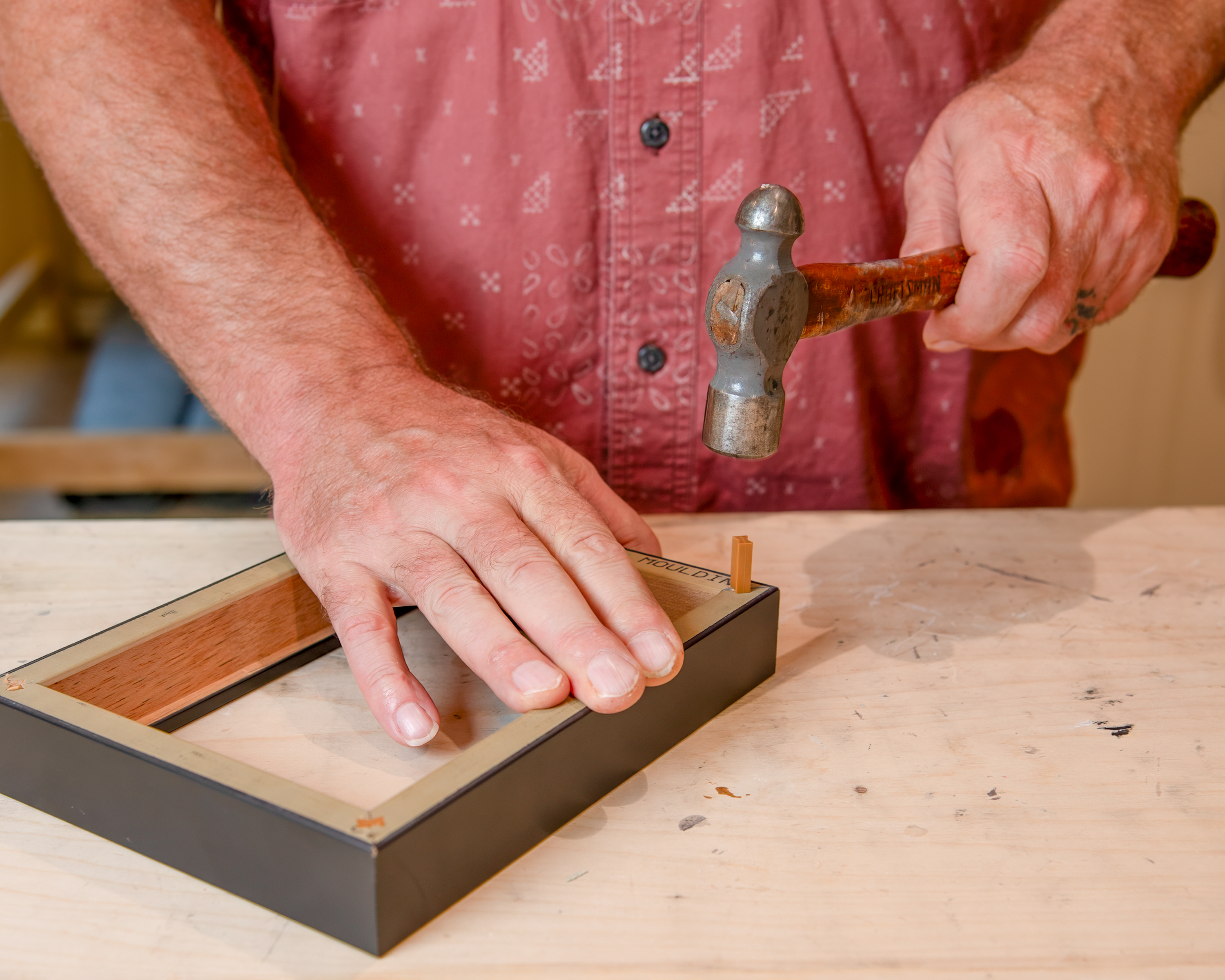
Here's the part most people never picture: the frame itself is built from raw lengths of moulding, cut and joined by hand. Each corner is cut at a 45-degree angle so two pieces meet in a tidy miter. Then those corners are joined — glued and fastened — so the frame is strong, square, and tight, with corners that line up cleanly. At our shop, Brian builds and cuts all of our frames, and that craftsmanship shows in every joint.
A well-joined corner is the difference between a frame that looks custom and one that doesn't. The miters have to meet with no gaps, the frame has to be perfectly square, and the whole thing has to be solid enough to hold glass, mat, backing, and your artwork for the long haul. This is where raw material becomes a real frame.
- Moulding is cut at precise 45-degree miters for each corner.
- Corners are glued and joined so the frame is square and strong.
- A tight, gap-free corner is the mark of true custom work.
Pro Tip: Run your eye along the corners of any frame — tight, clean miters tell you a skilled hand built it.
5. Fitting It All Together
The final step is fitting — layering the glass, mat, your artwork, and backing into the joined frame, then sealing and hanging-hardware are added so it's ready for your wall. Everything stacks in the right order, dust and debris are kept out, and the back is finished properly so the inside stays protected. Hanging hardware is chosen to match the weight of the finished frame.
This is where all the earlier precision earns its keep. If the measuring, cutting, and joining were done right, the fitting comes together clean and square. We treat this last stage with the same care as the first, because a treasure deserves to be sealed up well and hung securely. When it leaves our table in Tyler, Texas, it's ready to be enjoyed and protected at the same time.
- Glass, mat, art, and backing are layered in the correct order.
- The back is sealed to keep dust and debris out.
- Hardware is matched to the frame's weight for a secure hang.
Pro Tip: Ask how your frame should be hung. The right hanger for the weight keeps your piece safe and level.
What I've learned about custom framing after years in the field
I never set out to be a framer — I was studying communication and half-expecting to become the next Barbara Walters. But I fell in love with this craft because it takes both an analytical mind and a creative one, and almost nobody realizes how much judgment goes into a single frame until they watch it happen.
The biggest thing I've learned is that custom framing is genuinely a skilled craft, not something you knock out on an assembly line. Every one of the steps above involves a decision, and the right decision depends on your piece, your home, and your story. That's why we built our shop around framing by committee — five sets of trained eyes, and what we don't know, we'll research. We even keep framer mentors on speed dial for the trickiest jobs, because being certified means knowing when to ask.
We're also one of the few frame shops in East Texas with two Certified Picture Framers on our team, and that training shapes every corner we cut and every mat we choose. You can see examples of our work on our website. What makes us different is simple: we treat every item that comes through our door as if it were our own.
And honestly? Watching someone light up when they see the finished frame — that's the whole reason I do this. Job well done.
How Tricia's Rose City Framing helps you see the craft up close
If you've never thought about everything that goes into a custom frame, we'd love to show you. At Tricia's Rose City Framing in Tyler, Texas, we walk you through the whole process — measuring, choosing your mat and moulding, cutting, joining, and fitting — so you understand exactly how your frame is being made and why each choice matters.
We're a full-service custom frame shop, which means we handle everything from simple art prints to shadow boxes, three-dimensional objects, textiles, and heirloom documents. You get to collaborate on every visual choice, and you get the peace of mind of knowing certified hands are doing the work from start to finish.
Come see it for yourself. Visit Tricia's Rose City Framing or stop by our shop at 214 Shelley Dr in Tyler, Texas, and tell us what you'd love to frame. Love you. Have a great day.
FAQ
How are custom frames actually made?
Custom frames are made by measuring the artwork precisely, choosing a mat and moulding, cutting the mat and glass to size, cutting and joining the moulding into a square frame, and fitting everything together with proper backing and hardware. At Tricia's Rose City Framing in Tyler, Texas, each of those steps is done by hand by Certified Picture Framers, so the finished frame is both beautiful and built to protect what's inside.
How long does it take to make a custom frame?
The time it takes to make a custom frame depends on the materials chosen and the complexity of the piece, so timelines vary from one project to the next. We'll always give you an honest estimate up front at our Tyler, Texas shop and have it ready when we promise — keeping our word on timing is part of how we work.
What is the hardest part of making a custom frame?
The hardest part of making a custom frame is usually joining the corners perfectly square and gap-free, because even a tiny miter error shows in the finished frame. That's why we take our time cutting and joining the moulding by hand, and why we tackle the trickiest pieces as a team.
Can you custom frame three-dimensional or unusual objects?
Yes, Tricia's Rose City Framing custom frames three-dimensional objects, shadow boxes, textiles, and all kinds of unusual items, not just flat art. Our full-service shop in Tyler, Texas is set up for the kind of pieces that need extra depth, creative mounting, and careful handling.
Do I get a say in how my custom frame looks?
Yes, you absolutely get a say in how your custom frame looks — you choose the mat color, the moulding, and the overall style with us. We treat you as a collaborator so the finished frame reflects your personality, your home, and your decor, not a cookie-cutter formula.